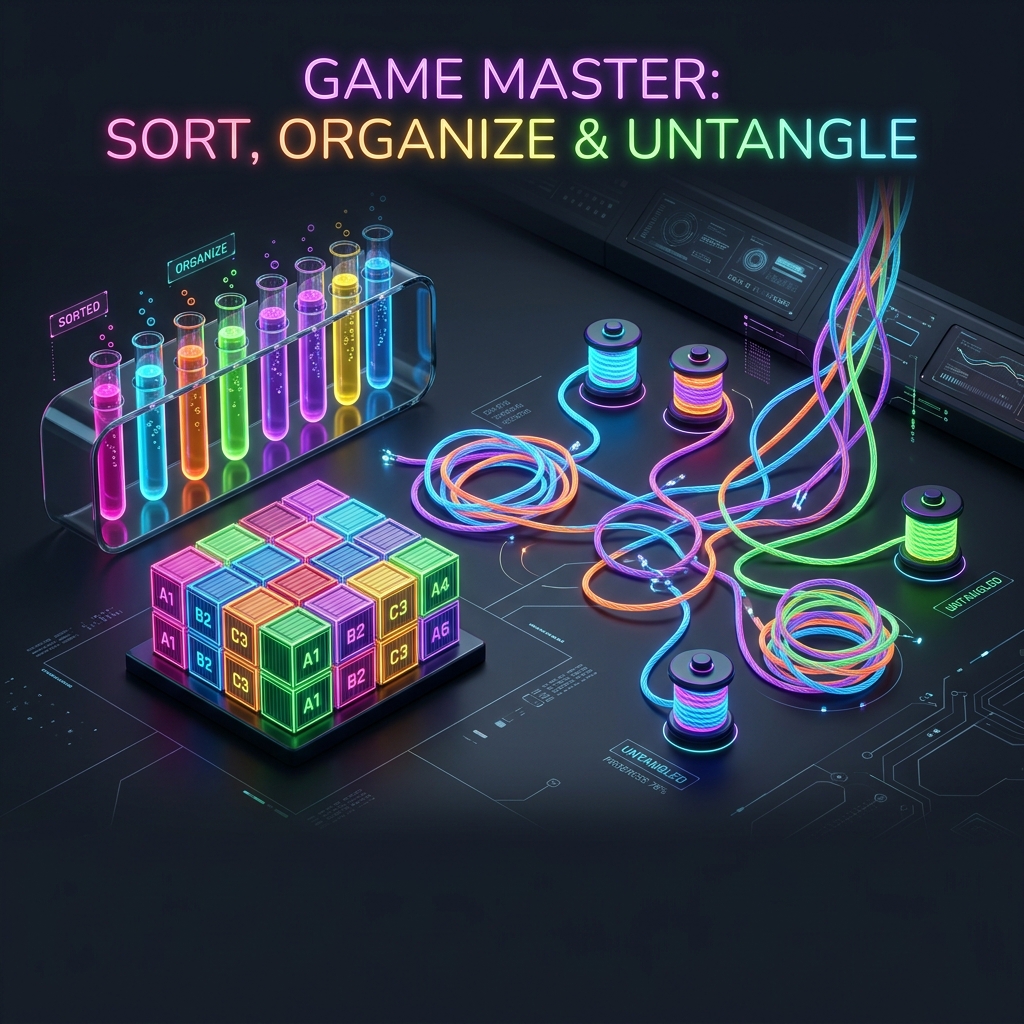
Sorting games start with a board that is visibly unfinished: mixed colors, crowded shelves, or crossing ropes. The goal is concrete, progress is easy to see, and every move changes the arrangement. That structure can make these games satisfying to some players.
This article uses “sorting game” literally. Obsessive-compulsive disorder is a real condition and is not shorthand for liking neat rows. These games are entertainment, not treatment.
Why the tasks feel clear
Each game gives the player a small rule set and an observable finish state. In Water Sort Puzzle, a tube should end with one color. In Cargo Crush Master, identical items must be collected without filling the temporary tray. In Twisted Rope Tangle, crossings must be removed by moving endpoints.
Immediate visual feedback also makes mistakes legible. A pour blocks a needed color, a shelf choice consumes a tray slot, or a rope move creates another crossing. The player can connect a decision with its consequence without following a long story or tutorial.
Three different forms of organization
Water Sort Puzzle
Colored layers can be poured only when the destination has room and accepts the top color. The important resource is empty space. Keep a spare tube available, expose buried colors deliberately, and avoid completing a tube if doing so blocks the only useful buffer.
Cargo Crush Master
The shelf is a visibility puzzle as much as a matching game. Selecting an item can reveal what is behind it, but every unmatched selection occupies a temporary slot. Look for a complete group before collecting isolated objects, and inspect partially hidden rows before the tray becomes crowded.
Twisted Rope Tangle
Here the challenge is spatial. Trace one rope from endpoint to endpoint and identify which crossing is on top. Moving a peg that affects several intersections can be more useful than fixing the nearest crossing first.
Reading the Game DNA labels
These games tend to place more weight on Mental because they use ordering, buffer management, or spatial preview. Reaction can remain low when there is no timer. Healing is an editorial label for pace and punishment; a high value does not mean a game treats stress, anxiety, or OCD.
Use the Game DNA tool to compare those gameplay requirements with the kind of session you want, then read the individual controls before launching a game.